Articles2026-01-01T03:05:53+00:00

MUSINGS

Creative Process Musings and Articles
Ikigai and creativity

It’s that time of year when no one quite knows what day it is. Are the shops open? Is it bin day? Why oh why is the sun setting at 3 in the afternoon! Welcome to the limbo land between Christmas and New Year.

Heading towards the annual day of Resolutions for Unrealistic Change (also known as the 1st January), I resolved not to make any this year. Instead I would take a moment to sense check my general direction and adjust if necessary. This meant spending a relaxing afternoon dipping into a book that suits the quiet and stillness of this time of year – Ikigai: The Japanese Secret to a Long and Happy Life by Héctor García and Francesc Miralles.

“The grand essentials to happiness in this life are something to do, something to love, and something to hope for.”

Ikigai loosely translates to “the happiness of always being busy“, it is a shorthand for your reason for being. Alongside the foundation stones of a good diet, good friends and exercise, the book outlines the role of finding your purpose and leaning into your passions. How, I wondered, could this be applied to a creative life?

At a practical level, it is helpful to develop an understanding of your creative purpose by thinking about it through 4 lenses: your passion, mission, profession and vocation. If you’re interested in thinking about your own Ikigai, take a moment to make a few notes about what each of these mean to you.

The overlap of your passion and mission is what you enjoy most, creatively it will show itself through your curiosity and attention. The subjects you return to again and again, the research you never tire of. The overlap between mission and vocation points to what the world needs from you, from a creative viewpoint this is the audience your work speaks to through your unique voice. The overlap between vocation and profession suggests what you can be paid for, your marketability and the story you and your work tells. The overlap between profession and passion showcases your skills and talents, these being the things you are good at.

The Venn diagram is provided in the book, around the outer edge are my thoughts on how it can apply to creativity, what demands your curiosity and attention? Chances are it is something that you love. Find your audience while staying true to your unique voice and it will point you to where your creative work fits in the world. Marketability and a story that resonates will ensure your work finds its audience and supports you to make a living.

I found it helpful to consider and reflect on these elements. It provided a useful compass check of my creative work and the direction I’m headed in for the year ahead.

January 1, 2026|Creativity, Library|

The Charm of Postcards in a Digital Era

Postcards. Are they still relevant?

In today’s fast-paced digital world are postcards a relic of connections and communications from a bygone era?

I have a nostalgia from my travelling days when I would regularly send postcards home to family that remains with me. I’ve come to appreciate that these small canvases have uses beyond their traditional purpose of mailing an update back home. I asked friends about the ways they use postcards, here are the ideas we came up with.

Personal connection

Postcards remind us of a time when handwritten correspondence was cherished. In an age dominated by emails and text messages, receiving a physical postcard evokes a sense of warmth and personal connection that lets be honest, emails lack. Whether it’s a vintage postcard from a flea market or a contemporary artwork created by an artist, each postcard carries a piece of history and human touch.

Frame them as small works of Art

Don’t want to send them? Then how about framing them as small works of art. As an artist, I find postcards to be an inspiring medium. The small, compact size presents a creative challenge and encourages me to distill my ideas. Sharing art on postcards allows it to reach a wider audience beyond the confines of galleries and exhibitions.

In addition to artworks printed on postcards, keep an eye out for postcard exhibitions. Usually for charity, these events invite artists to create original work in a postcard format and are sold or auctioned anonymously. The opportunity to own a piece of work by a well known artist is possible. A great way to start a collection. Framed postcard sized artwork is easy to incorporate into a gallery wall in your home.

Recipe cards

Postcards make delightful and practical recipe cards. With their durable material and compact size, postcards are perfect for jotting down favorite recipes or sharing culinary creations with friends and family. Whether it’s a family recipe passed down through generations or a recent addition, writing it on a postcard adds a personal touch to the cooking experience. Additionally, decorated recipe postcards can be gifted along with homemade treats, serving as both a delicious treat and a lasting memento.

Journalling

The intimate size and portability of postcards make them ideal for journaling on the go. Whether you’re traveling or exploring your own backyard, capturing thoughts, observations, and memories on postcards provides a record of life’s adventures. From capturing fleeting moments of inspiration to reflecting on personal growth, postcard journaling offers a unique blend of creativity and capturing thoughts. Moreover, exchanging postcard journals with friends or pen pals can spark meaningful conversations and connections across distances.

Book inserts

Postcards are charming inserts for books, adding a touch of personality and creativity to the reading experience. I regularly use them bookmarks and to my delight found a set of 3 postcards in a book by Franz Kafka purchased when I visited Prague some 20 years ago.

A postcard in a gifted book could be used for a personal note, for books lent, it provides a reminder to whom the book should be returned when finished.

Authors and publishers can include postcards with book purchases as promotional items or collectible memorabilia. A great way to engage their readers and build a sense of community.

Travel Souvenirs

One of the most traditional uses of postcards is as travel souvenirs. While digital cameras and smartphones have made it easier than ever to capture memories on the go, there’s something special about sending a postcard to loved ones from a faraway destination. A postcard can captures the essence of a place in a way that photographs often cannot. Additionally, collecting postcards from different places can serve as a visual diary of one’s travels, allowing memories to be preserved and revisited for years to come.

Acts of Kindness

In a world where acts of kindness are more important than ever, sending postcards can be a simple yet meaningful way to brighten someone’s day and spread positivity. Whether it’s a handwritten note of encouragement to a friend going through a tough time or a random act of kindness to a stranger, receiving a postcard in the mail can evoke feelings of joy, gratitude, and connection. Moreover, the act of sending postcards fosters empathy and community, reminding us of the power of small gestures in making a difference in someone’s life.

Share the list and inspire some postcard love!

In a world where acts of kindness are more important than ever, sending postcards can be a simple yet meaningful way to brighten someone’s day and spread positivity. Whether it’s a handwritten note of encouragement to a friend going through a tough time or a random act of kindness to a stranger, receiving a postcard in the mail can evoke feelings of joy, gratitude, and connection. Moreover, the act of sending postcards fosters a sense of empathy and community, reminding us of the power of small gestures in making a difference in someone’s life.

Share This Article!

March 4, 2024|Postcards|

Inspired by the Isle of Lewis

The Isle of Lewis – Echoes of the Past

Amid the noise of daily life, it’s easy to overlook the buildings and structures that stand around us. The stories of the people who commissioned, designed and built them are embedded within their walls. Not just physical shelters, they carry stories of the Island’s histories and culture.

My work aims to strip back unnecessary detail to capture their essence and give it a modern twist. My focus is the structure, not the environment it exists within, I want the viewer to experience it and consider its origins separate from its surroundings.

Echoes of Influence

My inspiration is rooted in curiosity. Why is it there? What is it for? Who made this happen? The buildings that inspire me reflect the cultures visiting the safe harbour of Stornoway’s town over several centuries. People have arrived and left their mark on this remote Island. Each building tells a part of this history and leaves tell-tale clues all around us.

Enhancing Our Lives Today

These buildings are part of our daily lives and shape our collective identity and sense of belonging. Whether it’s the role of a church in connecting its congregation as a community, or the bold statements of wealth that led to establishing a magnificent castle country home and estate overlooking a beautiful harbour. These architectural landmarks serve as visual anchors that ground us in our shared cultural heritage, fostering a sense of connection and community.

For generations, people have lived and thrived in the harsh conditions of the Hebrides. The structures left to us by our ancestors demonstrate their resilience and how they worked with the environment around them to make dwellings and places of cultural importance that stand to this day.

Translating Tradition into Art

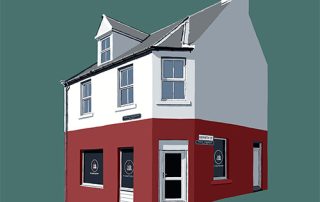
Working with graphic reduction I am seeking to distil the essence of a structures into visual compositions that resonate with modern contemporary audiences. My practice includes mixed media, painting, collage and digital. The Isle of Lewis series came about through drawing on my iPad as a way to test colour combinations and compositions. Over time these experiments developed into the standalone works you see here.

My process begins with exploring a structure from several angles at different times of day to find the right combination of light and shadow. Then onto photo editing software to correct perspective shifts created by the camera lens before selecting the 4 to 5 main colours from samples of the photo. Then the painstaking task of drawing the building begins. Each image takes around 20 to 30 hours to complete building the layers and deciding which details to keep and what to strip away.

Through my work I hope to inspire you to contemplate and discover the buildings around you and reflect on why they are important to you and your personal story. Whether it is a reminder of a visit to the Island where you experienced the Island hospitality for the first and only time, or a building that takes you back to regular visits or your childhood.

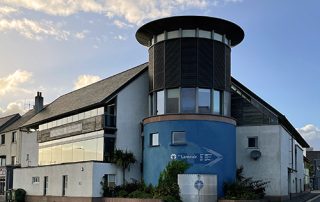
As an artist I am privileged to explore and celebrate the legacy of the Island’s built environment, from the 5000 year old Calanais Stones to our modern day Art Centre An Lanntair bringing us up to date in the 21st Century. I invite you to connect with our shared human heritage.

October 2, 2023|Inspiration|

Artist Gathering Talk 3rd March 2023

On the 3rd March, I had the opportunity to share my creative journey with a group of fellow artists, art enthusiasts and curious minds at An Lanntair’s monthly Artist Gathering.

I was invited to share how my personal experiences, interest in cultural movements and the work of other artists inspire and influence my work, in particular, the recent work on the Collective Memory Project.

Below is the transcript referred to throughout the talk. It explores my connection to the country of my birth and the aspects of it that have travelled with me and remain an enduring inspiration.

Thanks for the opportunity to talk about the Collective Memory project and my creative practice as a visual artist. For as long as I can remember I have been drawing and painting. I studied art throughout high school, but Art College was a pipe dream that I didn’t follow through on, until many years later when I applied for a place on an Edinburgh College of Art degree course. After 6 years of part-time study, I emerged with a practice working in mixed-media painting, mono-printing and moving image, mediums I still work in today.

Mono-print series completed in my last year of study. The series can be seen here.

I have been fortunate to travel widely throughout my life, and I am in no doubt the places and cultures I’ve experienced influence me creatively. Though perhaps most of all, the country and culture of my formative years lay the foundation stones for a lot of what was to come.

Stornoway is over 11 and a half thousand miles away from Dunedin, the city of my birth in New Zealand. Dunedin is Gaelic for Edinburgh, a city I later had the privilege of living in for over a decade before moving north to Stornoway. However, we only need to travel north about 200 miles from that original starting point to a small town called Pleasant Point in South Canterbury.

It was here that my experience throughout childhood into my mid-teens, would set a high bar for what it meant to be part of a community, living a life outdoors and in sync with the seasons, and experiencing the stunning natural beauty of those surroundings. Only after many years and places later did I appreciate just how privileged growing up there had been.

Pleasant Point is one of many small towns dotted across the fertile farming region of South Canterbury. On a clear day, the Southern Alps and New Zealand’s highest mountain, Mt Cook are visible. The town is notable for its steam locomotive, taxidermy, and delicious custard squares.

The township lies at the junction of two rivers. Each year, the swimming holes would shift after the snow melt passed through on its way to the coast. Wide riverbeds of smooth stones provided a playground of discovery every summer.

From the South Canterbury Museum Archive. A scene from the Tengawai River in 1979 showing the stoney river bed.

Stones have been a recurring theme appearing in my work for as long as I can remember. Around 2 years ago, the process of painting stones in the abstract reawakened a desire to create more generally and set me on the path I’m on now. That, and a ‘Covid lockdown epiphany’, had me asking the question why I didn’t make time to do something that brought me so much joy. This painting was to be the first of a series of rock paintings from visits to the stone beach at Barvas on the west (Atlantic) facing side of the Island.

However, those same riverbeds from my youth, also brought with them a devastating event that was to make a lasting impact.

In the early hours of March 13, 1986, over 200mm of water fell in the foothills. The sheer volume broke the banks of the river and flooded the town. Our family waded through a swollen creek to higher ground where we watched in shock as buildings and livestock were washed away. In the hours that followed, the 1200 residents were evacuated to the nearby town of Timaru. I remember not taking anything with us. I remember standing in a hall filled with donated clothing and being encouraged to take what I needed. I remember the kindness of strangers who took our family in for the next week while the water subsided and we were finally allowed to return home, fortunately to a relatively unscathed house, but some nearby were not so lucky.

Environment Canterbury – Historic Flood Events in Canterbury

Our house is visible in the top left hand corner of the image.

I was only a teenager, but the experience cemented the power of community, and I learned the comfort of being supported and lifted by strangers. I appreciate it now in this Island community too. There is a general acceptance, sometimes wariness, but usually caring and supportiveness, that is commonplace across small communities and here is no exception.

I am interested to how the role of the local community translates and influences my creative practice. Community Art as an art movement snuck past me during my years of study. Defined as an artistic activity that is based in a community setting, and characterised by interaction or dialogue with the community. I find myself drawn to the possibilities of co-creation and facilitation in the creative process.

Taking part in the Scotland-wide Culture Collective project has provided the opportunity to work with people in a way that is inclusive and brings a creative element, even if only for a short while, to the day for those taking part.

My Community Art project is titled Collective Memory. I bring images from Photographer TB Macaulay’s Archive out into the community to inspire and trigger stories and memories. TB Macaulay was a prolific photographer working from the 1910s through to the 1970s. He worked from his darkroom above a shop until his sight began to fail, at which point, he began painting in oils in an impressionist style. The archive is largely unpublished and contains a mix of day-to-day life in the Islands, newsworthy events, and records of his travels throughout Europe. Work is underway for the archive of photos to be made available publicly, but in the meantime, this project helps to share it with the community.

Through conversations with individuals and groups, the aim is to use the photos to stimulate memories and recall the senses evoked from the images such as sound and smell. The community’s participation in the process is captured in audio and emerging ideas will be incorporated into new works.

March 4, 2023|Creativity, Inspiration|

“The Dardanelles”

There is a long history of the artist capturing what is largely unnoticed. The two photos, “The Dardanelles” Looking North, and “The Dardanelles” Looking South are images of an unassuming lane in Stornoway. They are notable, because of their quiet and lack of remarkability. There are no people and in fact are not even evident on maps of Stornoway. So I met with the Stornoway Historical Society to learn more.

Listen to Malcolm Macdonald, Chair of the Stornoway Historical Society, talk about the area around the Old Fish Mart and the connections between Stornoway and the Dardanelles in France.

October 27, 2022|Culture Collective|

Starting close to home

Life with Dementia can be a disorienting experience, both for the person living with it and those connected to them. The pendulum swings between the confusion in the here and now and the comfort and safety of the past.

Images selected from the TB Macaulay Collection are used as conversation starters and prompts to encourage memories, sights, sounds, smells and emotions.

My first discussion was close to home. A relative of TB Macaulay and someone who knows his archive intimately. Due to sight loss, it was necessary to describe the images we discussed, it sometimes took only 3 or 4 words to bring the image to mind.

The images selected are from a folder that was shared publicly in the local library. The story goes that some of the the images were used without photographer acknowledgement so the folder was withdrawn. I acknowledge there is an element of pre-selection at work here, the images contained in the folder have already been through a selection process. I have the opportunity to explore the collection for lesser seen images to balance this out and include images that will be less known. In total I plan to work with a body of 20 images.

The interview illuminated experiences, sounds, smells, and stories of family and growing up in Stornoway so close to the harbour and fisherman’s catch.

TB Macaulay lived on North Beach, opposite Stornoway’s Inner Harbour. The booming fishing industry features in many of his images. The audio clip is of his daughter talking about what it was like living so close to the day’s catch.

October 15, 2022|Culture Collective|
Go to Top